

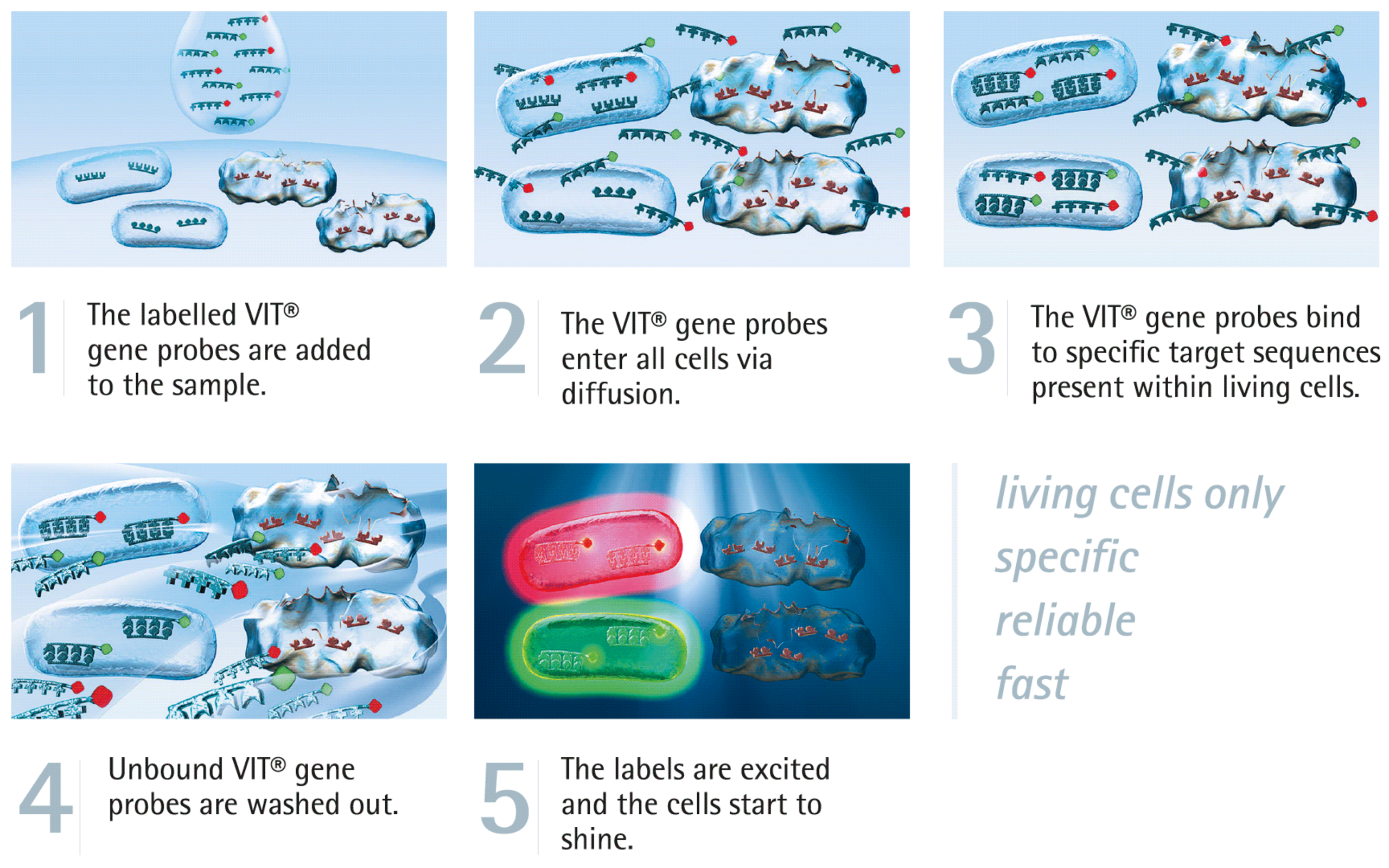
How VIT® works
The gene probe technology VIT® (vermicon identification technology) is the only technology that allows the highly specific visualization, identification and quantification of microorganisms.
Dye-labeled and specifically programmed VIT® gene probes penetrate the sample and bind highly specifically to the individual and living microorganisms. In the analysis, the luminescent and fully preserved microorganisms can then be quickly and reliably detected and quantified.

Speed
VIT® is fast! Detection is completed within three hours. Hands-on time only a few minutes.

Specificity
The VIT® gene probes are highly specific for individual species or entire groups. The design of the gene probes incorporates our concentrated know-how from over 20 years of gene probe research.

Reliable & robust
The cells are not destroyed in the sample and no target sites are extracted. The entire process does not require any enzymes that are susceptible to interference and is therefore very robust.
Use of FISH to analyze the microbiome
The human microbiome is a highly complex ecosystem consisting of bacteria, archaea, fungi, protozoa and viruses. This small universe of microorganisms is the subject of intense interest and research in the scientific communities. With the help of FISH (fluorescence in situ hybridization), bacteria can be analysed directly in their habitat.
Dr. Jiri Snaidr, CEO and founder of vermicon AG, explains how FISH works and what advantages it can offer, especially for scientists and companies involved in microbiome research.
Further development of FISH
The VIT® gene probe technology is the further development and industrial standard of FISH technology (Fluorescence In Situ Hybridization) for the detection of microorganisms. At the beginning of the 1990s, FISH was developed for the detection of bacteria at the Chair of Microbiology (Chair holder: Prof. Dr. Karl-Heinz Schleifer) at the Technical University. The spin-off vermicon AG was founded from this chair in 1997.
In the first years of its foundation, the company concentrated on further developing the FISH laboratory method into a robust technology that could be used in industry. In 2000, the VIT® gene probe technology was introduced.
VIT® combines all the advantages of FISH technology with added robustness and increased specificity. Today, VIT® is the industrial standard for FISH technology.
Only living bacteria | Proven worldwide | ||
|---|---|---|---|
| Only with VIT® can you be sure that the relevant living bacteria are detected. | VIT® has been used successfully worldwide for 20 years. |
The FISH Original

Since the development of FISH bacterial detection at the Chair of Microbiology at the Technical University of Munich, the FISH method has been used in research at universities worldwide. The results of the Department of Microbiology have been published internationally and have attracted worldwide attention.
With vermicon AG and its services, you can always be sure that you have the original. As a spin-off of the Chair of Microbiology, we have gathered and carefully developed the concentrated FISH know-how in our company from the very beginning.
Today, vermicon AG is a world leader in the application of FISH technology for the detection of microorganisms.
The advantages of VIT®
Direct: measurement of microorganisms directly in the sample without detours
Fast: quickest possible detection of changes; conclusions can be drawn quickly after changing process parameters
Only living bacteria: dead bacteria are not detected
Simple: no calibration necessary; no indirect parameters
Specific: precise identification of bacteria regardless of their morphology
Comprehensive: up to 100% of bacteria can be detected, regardless of their cultivability
Robust : no use of enzymes; interference-free
Stable: preserved samples allow reproducible statements over any period of time
You Might Also Be Interested in

Probiotics: Analysis and Quality Control
Improvement of the development and production process of probiotic bacteria through direct microbiology. Identity, purity, stability and viability (live/dead) directly in the sample

Biology of Wastewater
Why is the biology of wastewater so important? The biocenosis is the heart of every wastewater treatment plant. The stability and functionality of these microorganisms are crucial for effective biological wastewater treatment. The integration of…

Beer and Mixed Drinks
Microbiological quality control of raw materials and products in the brewing industry. Fast, specific and reliable - no inhibitors, no false-negative / false-positive results.