

Detection of Clinically Relevant Antibiotic Resistance Genes in Wastewater
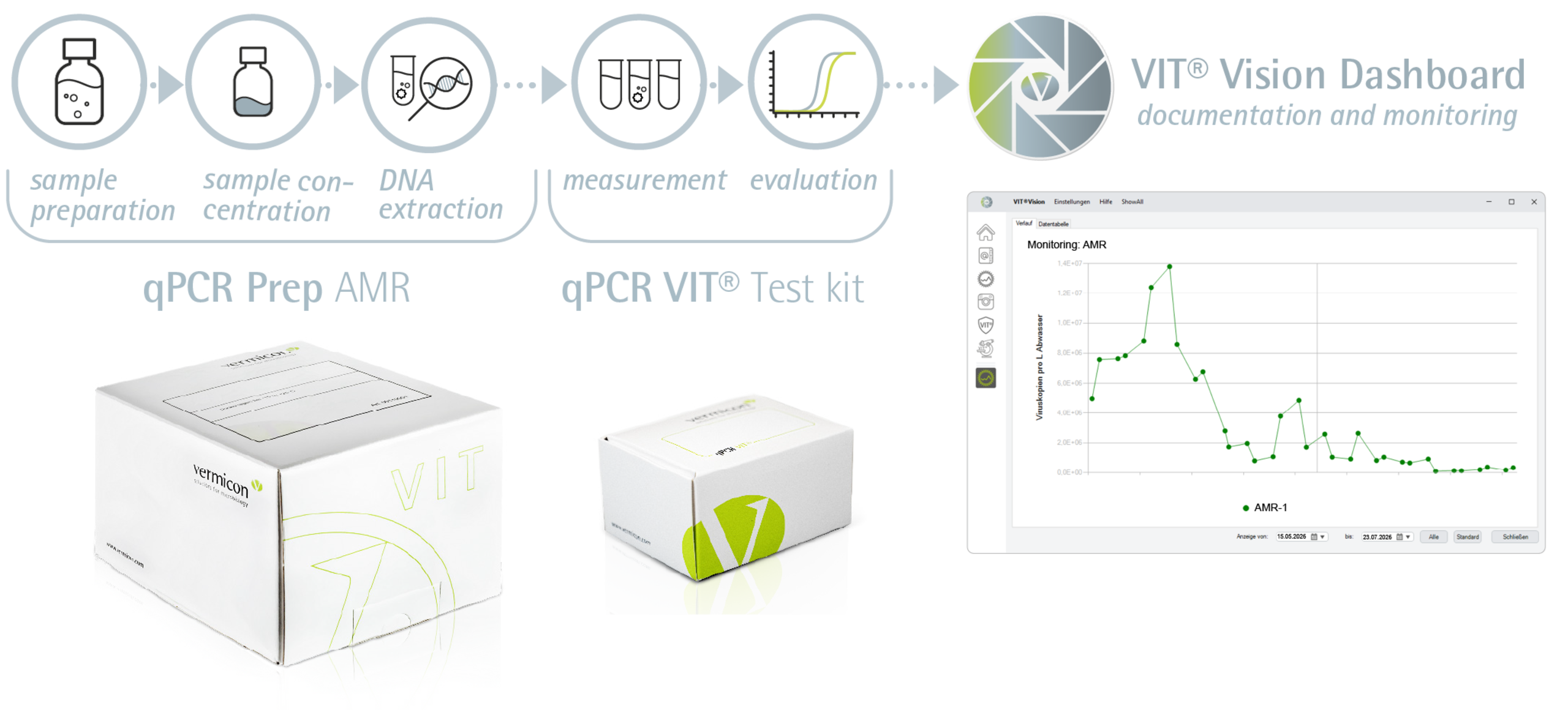
The qPCR VIT® AMR I Test Kit enables the specific and robust detection and quantification of the antibiotic resistance genes blaOXA-48-like, blaKPC , and blaCTX-M in treated wastewater samples using quantitative PCR (qPCR). The standardized analysis enables reliable and reproducible quantification of the selected target genes.
The blaOXA-48-like and blaKPC genes encode carbapenemases that confer resistance to carbapenems. Carbapenems are among the most important reserve antibiotics in human medicine. Genes of the CTX-M family encode extended-spectrum β-lactamases (ESBLs), which confer resistance to various β-lactam antibiotics.
The qPCR VIT® AMR I and qPCR VIT® AMR II test kits are used together for the molecular detection of selected antibiotic resistance genes and can be combined with the qPCR Prep AMR test kit for sample preparation to form a complete analytical system. In this combination, the three test kits enable simple and robust analysis of a broad spectrum of relevant antibiotic resistance genes in wastewater samples.
The vermicon AMR workflows are also used as part of the German nationwide AMELAG project by the Robert Koch Institute (RKI) and the German Federal Environment Agency (UBA) to analyze antibiotic resistance genes in complex wastewater samples.
Complete System for Detecting Antibiotic Resistance Genes in Wastewater
qPCR Prep AMR
Purification of wastewater samples for molecular biological qPCR analysis of antibiotic resistance genes
qPCR VIT® AMR I
Detection of β-lactam resistance genes:
- blaOXA-48-like,
- blaCTX-M, and
- blaKPC
qPCR VIT® AMR II
Detection of the β-lactam resistance gene and the sulfonamide resistance gene:
- blaNDM
- sul1
Your Benefits
Specially developed by experts in wastewater analysis. The optimized workflow ensures reliable detection of antibiotic resistance genes, even in complex wastewater samples with varying compositions.
Using a multiplex approach, it simultaneously detects the β-lactam resistance genes blaOXA-48-like, blaCTX-M, and blaKPC. This allows for the detection of genes encoding clinically relevant carbapenemases and extended-spectrum β-lactamases (ESBL) in a single test run.
The three resistance genes and the bacterial reference marker 16S rDNA are detected and quantified in parallel using a multiplex qPCR assay. The reference marker is used to normalize the results and enables standardized and comparable analysis.
The AMR workflows developed by vermicon AG are being used as part of the German nationwide AMELAG project for the molecular biological qPCR analysis of antibiotic resistance genes in wastewater. The findings obtained through this work are continuously incorporated into the optimization and further development of the analytical methods.
The qPCR VIT® product line is a comprehensive system for wastewater surveillance. It combines sample preparation, analysis, evaluation, and monitoring of health-related viruses and antibiotic resistance genes—to provide scientifically sound, comparable, and reliable data.
Directive (EU) 2024/3019 mandates the monitoring of antimicrobial resistance in municipal wastewater. The qPCR VIT® AMR product line enables the standardized detection of selected antibiotic resistance genes, thereby supporting the implementation of such AMR monitoring.
Product Specifications
| Detection | Molecular qPCR-based detection of the β-lactam resistance genes blaOXA-48-like, blaCTX-M, and blaKPC in wastewater samples |
| Detection control | Positive and negative controls |
| Universal bacterial reference marker 16S rDNA as an in-process control during sample preparation | |
| Classification of the measured resistance gene concentrations using 16S rDNA as a marker for total bacterial load | |
| Result | Quantitative detection of antibiotic resistance genes using qPCR analysis |
| Report of results in, for example, gene copies/L using quantification standards included in the test kit | |
| Contents | All essential consumables are included in the test kit |
| Package Size | 100 reactions per kit |


You Might Also Be Interested In

Wastewater-based Epidemiology
Wastewater-based epidemiology is an effective tool to support public health management. The monitoring of health-relevant viruses and bacteria (e.g. SARS-CoV-2, influenza and RSV) in wastewater is not only a fast and cost-effective method, but also a…

Laboratory Analysis of Viruses
Would you like laboratory analytics? Order your sample analysis now. Detection is carried out using our qPCR test kits. Sampling is performed independently with the help of our sampling kits. The procedure is suitable for wastewater treatment plants…

Virus Detection
Our test kits enable continuous monitoring of health-relevant viral loads in wastewater samples. They are optimized for the specific requirements of the wastewater sector and enable precise evaluation of RNA and DNA virus particles.