

Wastewater is Not a Black Hole
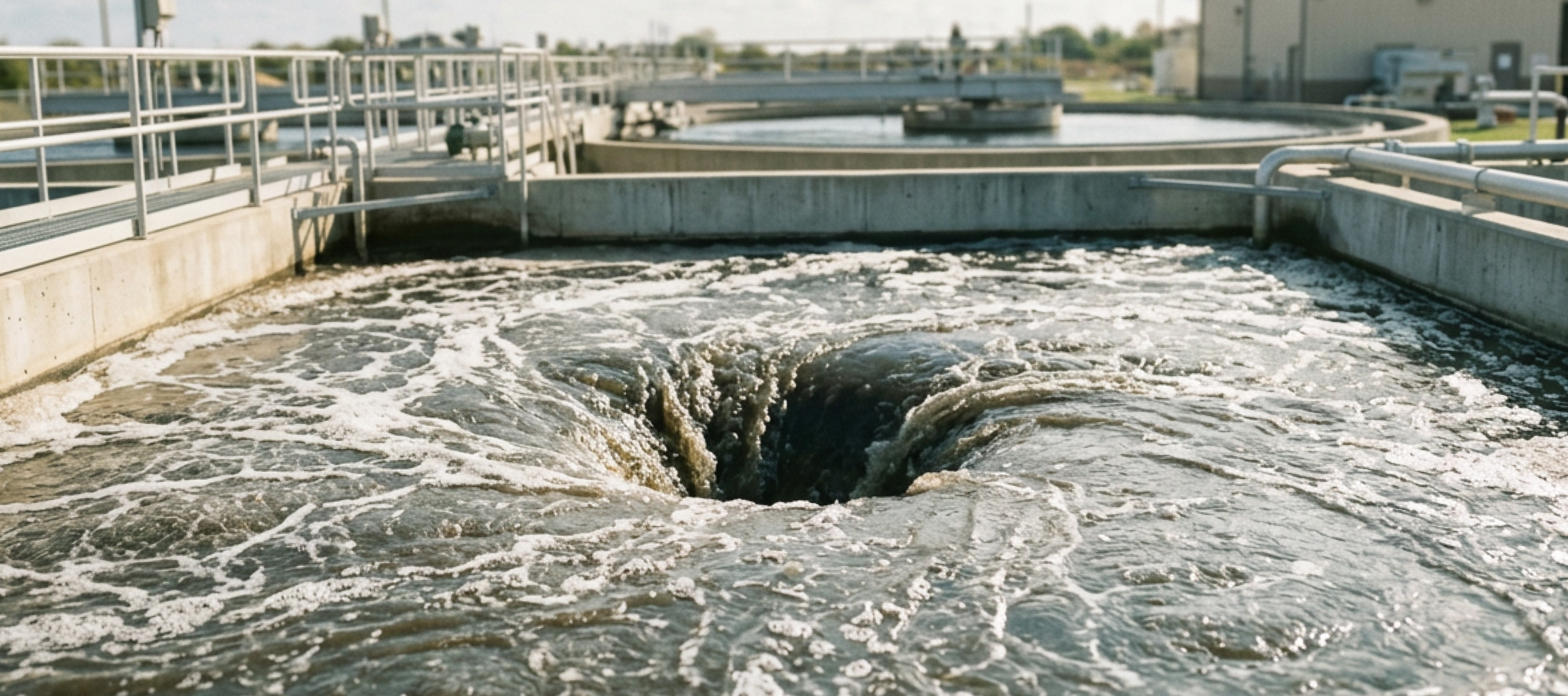
In a biological wastewater treatment plant, microorganisms perform the actual treatment work. They break down organic pollutants, remove nitrogen compounds, influence the sludge structure, and ultimately determine whether a plant operates stably or experiences a malfunction.
Nevertheless, the biological processes in many plants are still primarily assessed indirectly. Oxygen consumption, sludge volume index, ammonium, nitrate, phosphate, or chemical oxygen demand indicate how the process is currently functioning. However, they often do not explain why a process changes.
Wastewater analysis thus often describes the consequences. Microbiological quantification, on the other hand, can reveal some of the underlying causes.
Not All Bacteria Perform The Same Function
Activated sludge does not consist of a uniform biomass. It is a complex ecosystem comprising numerous bacterial groups, archaea, fungi, protozoa, and other microorganisms. Within this system, different populations perform different functions.
Some bacteria oxidize ammonium to nitrite. Others convert nitrite to nitrate. Under suitable conditions, denitrifying bacteria reduce nitrate to gaseous nitrogen. Certain organisms store phosphate. Others break down organic compounds that are difficult to utilize or are involved in the formation of stable flocs.
At the same time, individual bacterial groups can cause technical problems. Filamentous organisms can promote bulking sludge, floating sludge, or foam formation. Sulfate-reducing bacteria can produce hydrogen sulfide. Other populations contribute to corrosion, odor formation, or deterioration of sludge properties.
The total number of bacteria alone therefore says little about the functional state of a wastewater treatment plant. What matters is which bacteria are present and in what quantities.
Presence Does Not Mean Relevance
The mere detection of a microorganism initially answers only a qualitative question: Is the target bacterium present or not?
This information is often insufficient for process evaluation. Many microorganisms can be present in low concentrations without measurably affecting operation. Only when their population increases or reaches a certain ratio relative to other groups does functional or technical relevance arise.
A positive result is therefore not automatically a problem. Conversely, a negative result does not necessarily mean that the function in question is absent from the process. It may be performed by another group, or the population may be below the limit of detection.
Only quantification transforms a detection into reliable process information.
Total Biomass and Specific Population Are Two Different Parameters
In wastewater treatment, attempts are often made to estimate microbial activity using general biomass parameters. These include, for example, dry matter, loss on ignition, ATP, or nonspecific cell counts.
These values can provide important information. However, they do not distinguish between the functional groups within the biomass.
Two activated sludges may have similar total biomass yet differ fundamentally in microbiological terms. One sludge may contain a stable population of nitrifying bacteria. The other may also have a high biomass, but only small amounts of the organisms critical for nitrogen removal.
Total biomass describes the size of the system. Specific quantification describes its composition.
Functional Groups Instead of Individual Species
In many technical processes, a single bacterial species is not solely responsible. Often, several phylogenetically distinct organisms perform the same or a similar function.
This applies, for example, to nitrification, denitrification, phosphate removal, or the degradation of certain organic substances. An analysis that considers only a single species may therefore be insufficient.
Quantifying functional or phylogenetic groups provides a broader perspective. It captures not just a single representative, but a relevant portion of the population involved in a process.
The definition of the target must be precise. A probe that is too narrow may overlook important organisms. A probe that is too broad may capture populations that are genetically similar but functionally different.
The quality of the quantification therefore depends directly on the biological specificity of the detection system.
Detecting Changes Before the Process Tips Over
Many biological disturbances do not develop suddenly. They begin with a shift within the microbial community.
For example, the population of slow-growing nitrifiers may already be declining before the ammonium level in the effluent rises significantly. Filamentous bacteria may proliferate before the sludge volume index deteriorates significantly. Certain foam- or floating sludge-forming organisms may increase before the problem becomes visible at the surface.
Specific quantification thus makes it possible to detect developments earlier.
However, it is not an automatic early-warning system. A single measurement provides only a snapshot. Quantification becomes truly meaningful primarily through repeated measurements, reference values, and correlation with operational data.
The trend is often more important than the individual value.
Root Cause Analysis Instead of Symptom Management
When a plant experiences problems with nitrification, sludge settling, or foaming, operational parameters are often adjusted first. The sludge age is adjusted, aeration is increased, return sludge flows are modified, or chemicals are added.
Such measures can be useful. However, without knowledge of the microbiological cause, they remain somewhat nonspecific.
A high ammonium level may be due to an insufficient number of nitrifying bacteria. However, it can also be caused by oxygen deficiency, inhibitors, an unfavorable pH, low temperature, lack of alkalinity, or hydraulic overload.
Quantifying the relevant bacterial groups helps distinguish between these possibilities. If the target population is present but the process is not functioning, the problem may lie more with the environmental conditions. If the population is significantly reduced, the cause of the loss or lack of growth must be investigated.
This allows for more targeted process optimization.
Spatial Distribution as Additional Information
Microorganisms in activated sludge are not distributed randomly. Many live in flocs, biofilms, or aggregates. Within these structures, different oxygen, substrate, and redox gradients develop.
Spatial position can therefore determine which function a bacterium can actually perform.
VIT® makes it possible to visualize specific bacteria directly within their natural structure. This not only allows us to determine whether a target group is present, but also to assess whether it is integrated into flocs, freely distributed in the water, or organized into unusual aggregates.
This information is lost in many purely extraction-based methods.
From Individual Analysis to Microbiological Process Profiling
The greatest benefit is realized when specific quantifications are performed not only during acute disturbances.
Regular measurements can generate a microbiological reference profile for each facility. This reveals which population sizes are typical under stable conditions, the extent of seasonal fluctuations, and which changes precede certain operating conditions.
Such a database can answer several questions over the long term:
- Which bacterial groups characterize stable operation?
- What changes occur before a disturbance?
- How do temperature, load fluctuations, industrial discharges, or process changes affect the microbial community?
- How quickly does a functional population recover after a collapse?
As a result, microbiological analysis evolves from a one-off investigation into a tool for process control.
Measuring What Actually Sustains the Process
Biological wastewater treatment works only because specialized microorganisms perform specific tasks. Nevertheless, these organisms are often not directly measured during daily operations.
The specific quantification of bacteria and bacterial groups closes this information gap. It reveals which functional populations are present, how large they are, and how they change over time.
It neither replaces traditional operating parameters nor chemical analysis; rather, it complements them by adding the biological level at which the actual treatment takes place.
Looking only at effluent values tells you whether a wastewater treatment plant is functioning.
But by also quantifying the relevant bacteria, one gains a better understanding of why the system works and when that might change.