Safety and Precision in Probiotic Stability Studies with L/D-Staining and Flow VIT®
Importance of Stability and Shelf-Life Studies for Microbiological Products
Probiotic products have become a key component of the health and nutrition market in recent years. They contain living microorganisms, whose viability is crucial for their effectiveness. Only if the bacteria survive in sufficient numbers until the time of consumption can they perform their functions in the gut.
To ensure this, manufacturers conduct stability and shelf-life studies. These studies test how long a product remains stable under defined storage conditions, forming the scientific basis for determining the best-before date (BBD). The absence of reliable stability data entails considerable risks: a too short BBD can lead to unnecessarily high recall and disposal costs, while a too optimistic BBD risks consumers receiving a product that is no longer effective.
The precise determination of the viability of the probiotics contained is therefore not only a regulatory requirement but also a decisive factor for consumer trust, product safety, and market success.
Classical Methods: L/D Staining as the Standard – Possibilities and Limitations
Traditionally, stability studies in microbiology are based on culturing cells on nutrient media. However, these methods are time-consuming, do not capture all culturable cells, and are laborious for anaerobes. Many living but non-culturable (VBNC) bacteria remain invisible.
In recent years, Live/Dead staining (L/D staining) has become the standard. Fluorescent dyes penetrate intact and damaged cell membranes differently, allowing living and dead cells to be distinguished based on their fluorescence signal. The method is fast, provides quantifiable results in a short time, and gives a more realistic picture of the total number of viable cells than classical plating.
However, there is a crucial limitation: L/D staining is non-specific. It shows the total number of living and dead bacteria but does not indicate which strain in a mixed culture survives. Especially in probiotics, which often consist of several strains or species, this is a major drawback. If an important strain is lost during storage, the effectiveness of the entire product can be compromised, without this being detectable by classical L/D staining.
Extension with Flow VIT®: Making Specific Fractions Visible
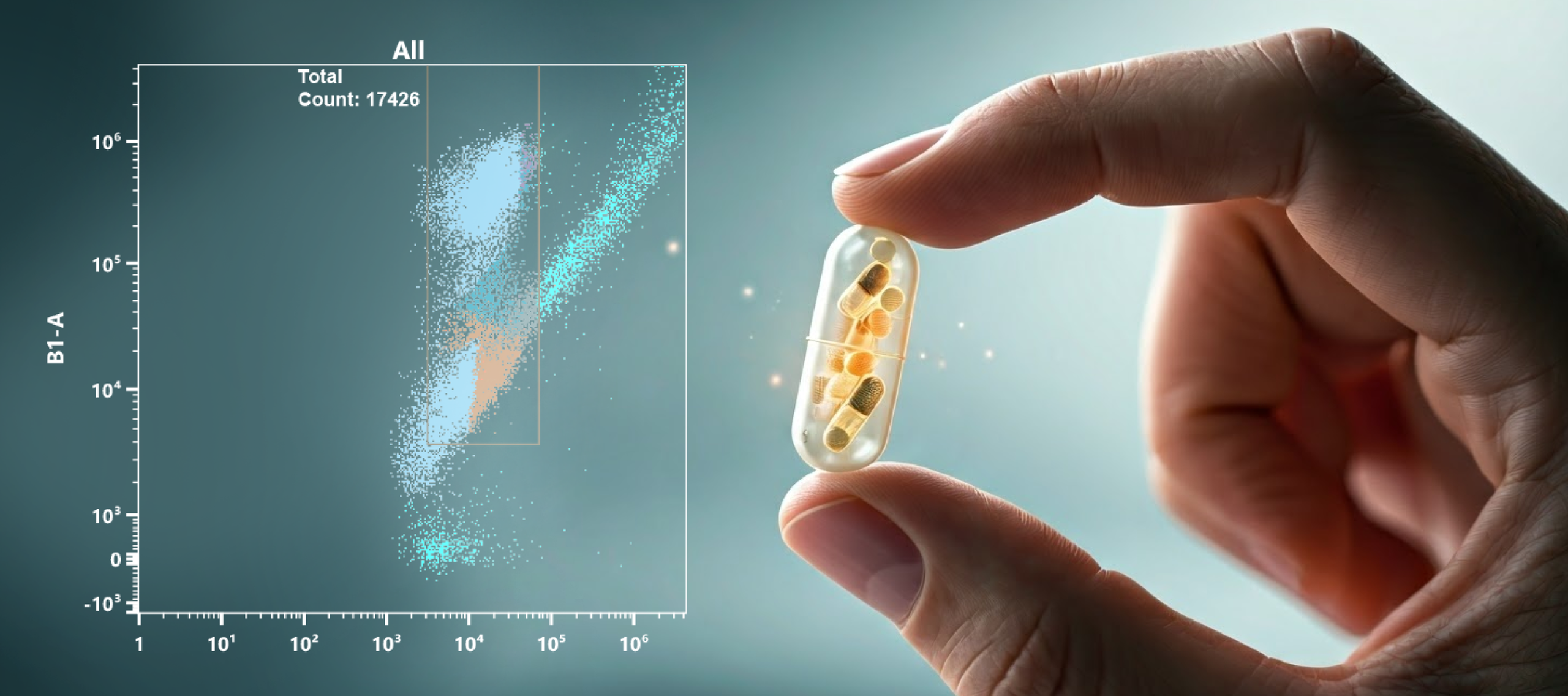
This is where Flow VIT® comes in – a method that combines the advantages of flow cytometry with vermicon’s VIT® gene probe technology. Fluorescently labeled gene probes specifically bind to the ribosomal RNA of target organisms. Combined with flow cytometry, this enables targeted identification and quantification of bacteria in a sample.
The special feature: Flow VIT® not only distinguishes between living and dead cells but also identifies which organism survives. This closes a gap that previously existed in stability studies. While L/D staining provides a quick overall view, Flow VIT® allows specific monitoring of individual relevant bacteria.
The combination of both methods significantly increases informative value: it makes visible whether a critical probiotic strain remains stable even in the final months of storage. At the same time, early deviations can be detected, enabling manufacturers to react in time and adjust formulation or packaging. Moreover, the results provide robust data that allow the BBD to be scientifically justified and clearly communicated to authorities and business partners.
Practical Relevance: Probiotic Stability in Focus
The practical significance of this method combination is evident throughout the entire development and quality assurance process of probiotic products:
- BBD determination: Only if it is known how each individual strain behaves over the entire shelf life can a reliable best-before date be specified. Flow VIT® provides the necessary precision.
- Storage conditions: Stability studies under different temperature or humidity conditions show how sensitive the strains are. This allows optimal storage recommendations to be formulated.
- Product formulation: Powders, capsules, or liquid preparations have different stability profiles. With the method combination, different formulations can be objectively compared and specifically improved.
- Quality assurance: Regular controls throughout the entire shelf life ensure that the guaranteed amount of viable probiotics is maintained until the very last day of the BBD.
Thus, stability testing evolves from a mere regulatory obligation into a strategic tool that determines product success and market acceptance.
Conclusion: More Safety and Precision in Shelf-Life Assessment
Stability and shelf-life studies are far more than formal necessities. They are the foundation for ensuring that probiotic products meet consumer expectations and regulatory requirements.
The combination of L/D staining with Flow VIT® establishes a new standard: it unites the speed and simplicity of total viable cell determination with the precision of specific analysis. The result is reliable, differentiated, and traceable data that provide manufacturers with a high level of confidence.
For the probiotic industry, this means more transparency, higher product quality, and a maximum of consumer protection. For the end customer, it is the guarantee of receiving a product that remains effective until the very last day of the specified BBD.