

The Wastewater Treatment Plant is Alive. We Should Take a Closer Look.
Wastewater is More Than Just a Technical Medium
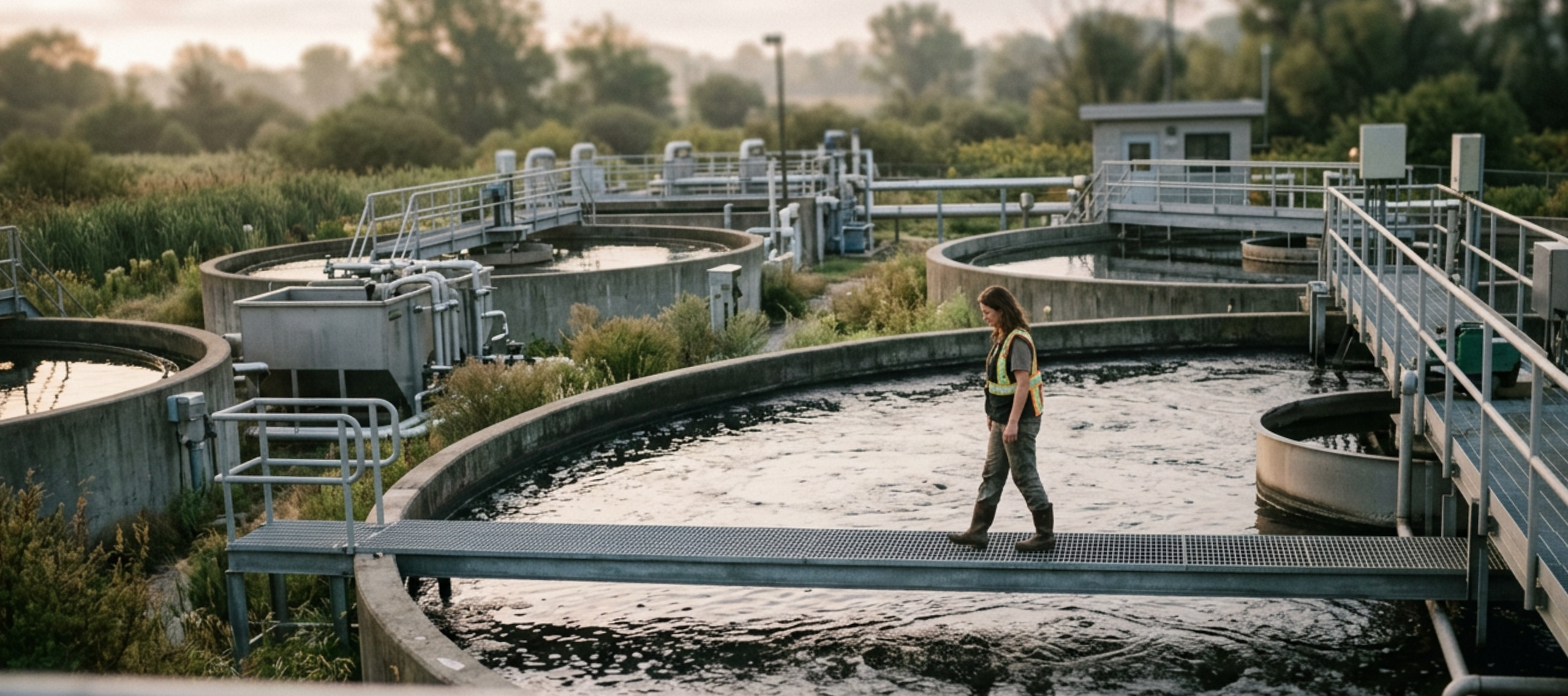
When we talk about wastewater, many people first think of treatment—of tanks, pumps, oxygen, sludge, regulatory limits, and effluent quality. That’s understandable, because that’s exactly why wastewater treatment plants were built. They’re designed to remove contaminants from the water and ensure that treated water can be safely returned to the environment. This task remains central. But it describes only a part of what actually happens in a wastewater treatment plant.
Wastewater is not just a technical medium. It is also a biological stream of information. It contains a record of what happens in households, businesses, hospitals, and entire cities. Not as neatly separated individual pieces of information, but as a complex mixture of chemical, physical, and microbiological signals. That is precisely what makes wastewater so challenging. And that is precisely what makes it so interesting.
Traditional Analytics Doesn’t Capture the Whole Picture
For a long time, wastewater was understood primarily through traditional parameters. COD, BOD, nitrogen, phosphorus, pH, temperature, oxygen, and sludge index remain important parameters to this day. No one would seriously dispute that they are indispensable for the operation of a wastewater treatment plant. They describe what pollutants are present, how heavily a process is being stressed, and whether the plant ultimately meets the required effluent standards. What they reveal only to a limited extent, however, is the biological reality behind these values.
Yet that is precisely the core of biological wastewater treatment. A wastewater treatment plant does not function because technology alone purifies the water. It functions because microorganisms carry out metabolic processes under controlled conditions. They break down organic matter, oxidize ammonium, reduce nitrate, store phosphorus, form flocs, compete with one another, and respond to changes in the influent. The technology creates the conditions. The actual work is done by microorganisms.
This may sound obvious, but it is often underestimated in practice. When nitrification weakens, it is not merely an abstract plant-level problem. It is, first and foremost, a microbiological problem. When flocs become unstable, when foam forms, when filamentous bacteria increase, or when a process suddenly slows down, there is rarely just a single chemical parameter behind it. It usually involves shifts within a microbial community. Some organisms gain importance, while others lose it. Some functions remain stable, while others come under pressure.
That is why it is not enough to simply ask what values a plant is measuring. What is also crucial is the biology behind these values. Only then does process control become a true understanding of the process. Classical analytics shows that something is happening. Microbiology can explain why it is happening.
The Wastewater Treatment Plant as a Biological Observation System
This is precisely where a different perspective on wastewater begins—not as a waste stream, but as a diagnostic system. Wastewater can provide clues before problems become fully apparent. It can reveal whether certain functional groups are consistently present in the microbial community, whether a process is moving in a critical direction, or whether pollutants from the watershed are altering the microbial community. This transforms the wastewater treatment plant not only into a place of purification but also into a place of observation.
During the COVID-19 pandemic, it became clear that wastewater can serve as an early warning system for infectious disease outbreaks. This idea was new to many, even though the principle behind it is obvious. What people excrete ends up, in part, in the wastewater. What can be measured there can provide clues about developments within a population. Not about individual people, but about collective trends. This made it clear that wastewater can contain information that goes far beyond traditional plant control.
This concept will continue to evolve. A current example is the monitoring of antimicrobial resistance. Antibiotic resistance is not purely a clinical issue. It arises, spreads, and evolves within a broader microbiological and ecological context. Wastewater provides a particularly interesting window into this, as it is where human, industrial, medical, and environmental factors converge. It is not a perfect picture of reality, but it is a relevant one. Precisely for this reason, wastewater will increasingly be understood in the future as an integral part of a modern environmental and health infrastructure.
The Right Question Determines the Right Analytical Approach
This makes sense from a technical standpoint, but it is also challenging. After all, the more we want to glean from wastewater, the more important the quality of the analysis and interpretation becomes. It is not enough to simply add new parameters to a list or generate ever-larger amounts of data. What matters is whether the results are biologically valid and can be interpreted meaningfully. This is particularly challenging when it comes to microbiological data.
A resistance gene does not automatically pose a risk of the same magnitude. A DNA sequence does not necessarily mean that an organism is alive or active. A change in the magnitude of a signal does not always imply a change in function. And a single measurement is rarely as informative as a well-understood time series. That is why wastewater analysis of the future needs not only more methods, but above all, better questions.
The more precisely the question is framed, the more effectively the appropriate analytical methods can be selected. In the field of wastewater, therefore, the goal is not to apply individual methods as broadly as possible in parallel. What matters is which level of the system needs to be understood. When it comes to the active biology of a wastewater treatment plant, VIT® analyses can reveal which microbial groups are present in the process and what role they play. When the focus is on viral loads or epidemiological questions, specific viral analysis takes center stage. And when it comes to functionally classifying the biological activity of the sludge, VIT® ABM provides an additional layer of information.
VIT® ABM shows what proportion of the dry matter in the process is actually biologically active. This adds a functional dimension that is often missing in traditional analysis. This is because understanding a biological treatment stage depends not only on how much biomass is present as dry matter, but also on how much of this biomass is actually actively involved in the process.
VIT®, virology analysis, and VIT® ABM therefore do not answer the same question, but rather address different levels of the same system. Direct microbiology at the wastewater treatment plant reveals which organisms and functional groups support or disrupt the process. Virological analysis can provide clues about contamination from the watershed. VIT® ABM complements this perspective by addressing the question of how much of the existing biomass is actually biologically active. Therefore, the key is not to compare as many methods as possible side by side, but to match the right microbiological question with the appropriate analytical method.
Digital models require biological reality
This is especially true for modern concepts such as digitalization, AI, or digital twins. Of course, these approaches will play a role in water management. It can be very useful to better link operational data, model processes, and control facilities more efficiently. But a digital model is only as good as the reality it represents. If microbiology is missing from the model, an essential part of the wastewater treatment plant is missing.
A biological treatment stage is not a purely hydraulic or chemical system. It is a living system. It does not always react linearly. It exhibits inertia, resilience, tipping points, and competitive relationships. It can absorb loads until it suddenly can no longer do so. This is precisely why direct microbiology is so valuable. It complements traditional process control not merely superficially, but substantively.
Greater Understanding of the System’s Own Biology
For operators, this does not mean that every wastewater treatment plant must be continuously monitored with maximum diagnostic capabilities. That would be neither realistic nor economically sound. However, microbiological information should be used wherever it improves decision-making. In cases of recurring operational problems, industrial discharges, unstable nitrification, bloated sludge and foam, issues surrounding antimicrobial resistance, and wherever traditional parameters indicate that something is happening but fail to explain why it is happening.
This doesn’t make wastewater any simpler. But it does make it easier to understand. Perhaps that is precisely where the real change lies. The wastewater treatment plant of the future will not only have to deliver cleaner effluent quality. It will also need more knowledge about its own biology. Because only those who understand the microorganisms that drive the process can truly understand biological treatment.
Wastewater is thus no longer merely a disposal problem. It is a technical, ecological, and microbiological information system that we are only just beginning to interpret correctly. And perhaps that is the most important change: we are no longer looking only at what comes out of the plant at the end. We are beginning to understand what is really happening inside.