

What Happens to Resistance Genes at the Wastewater Treatment Plant
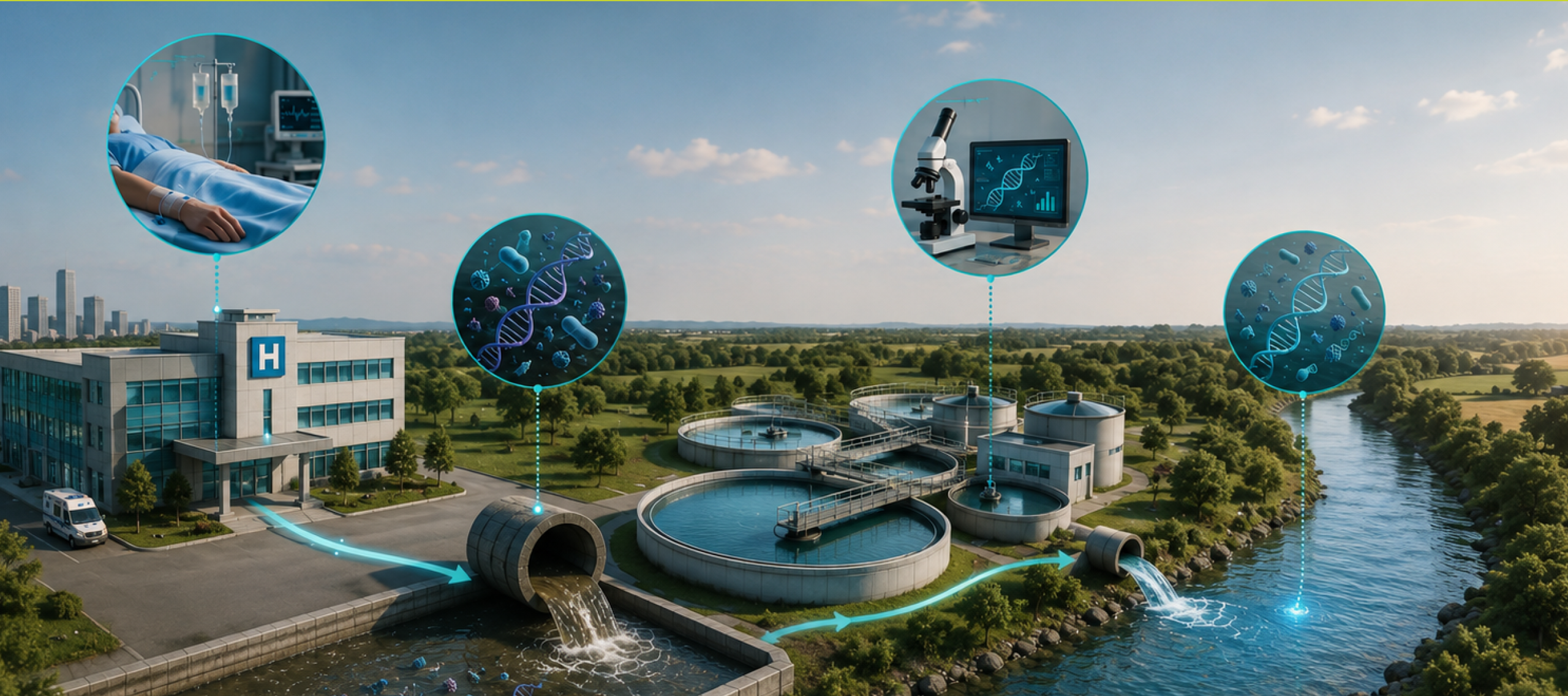
Antibiotic resistance is usually detected where it causes immediate problems: in hospitals, doctors’ offices, or microbiology laboratories. A pathogen is isolated, its susceptibility to various antibiotics is tested, and an appropriate treatment is determined based on those results. This is essential for treatment. However, this approach is inevitably incomplete when it comes to monitoring an entire population, as it captures only those individuals from whom a sample was actually taken and tested.
Wastewater, on the other hand, offers a completely different perspective. Every day, enormous quantities of bacteria enter the sewer system via human excreta. Among these are resistant bacteria and bacteria that carry resistance genes. Added to this are free bacterial DNA, antibiotic residues, and other antimicrobial substances. At the inflow of a larger wastewater treatment plant, these signals from thousands or hundreds of thousands of people mix together. This creates a kind of microbiological composite sample representing an entire catchment area.
This fact makes wastewater an interesting source for monitoring antimicrobial resistance. However, this involves more than just the question of which resistance genes are present in a population. A wastewater treatment plant is itself a highly complex microbial ecosystem. Therefore, it is at least as fascinating to examine what happens to resistant bacteria and their genes during the wastewater treatment process.
The Microbial World Changes in Activated Sludge
An intestinal bacterium that enters the sewer system via the toilet encounters living conditions in the wastewater treatment plant that are completely different from those in the human intestine. Temperature, oxygen supply, nutrient availability, and competition from other microorganisms change fundamentally. Many typical fecal bacteria cannot establish themselves permanently under these conditions. They are degraded, washed out, or removed from the aqueous phase along with the sludge.
However, this does not automatically mean that all resistance genes disappear as well.
The activated sludge in a wastewater treatment plant is not a random collection of bacteria washed in. It consists of a highly selected microbial community that has adapted to the specific operating conditions over a long period of time. Nitrifying bacteria, denitrifiers, phosphate-accumulating organisms, and numerous heterotrophic populations grow in dense flocs and aggregates. Through the recirculation of activated sludge, many of these microorganisms remain in the system for numerous generations.
As a result, the wastewater treatment plant develops its own resistome—that is, its own composition of antibiotic resistance genes. The resistance profile of the activated sludge is therefore not simply a diluted version of what arrived in the influent. Some resistance genes decrease, others persist, and still others may be relatively more prevalent within the bacterial community established there.
Are Wastewater Treatment Plants Really “Resistance Factories”?
This is precisely where caution is warranted when making sweeping statements. Wastewater treatment plants are occasionally referred to as “resistance factories.” While this sounds dramatic, it does not adequately describe the biological processes at work. Wastewater treatment plants harbor large quantities of bacteria and, consequently, many resistance genes. As such, they initially serve as an important barrier. At the same time, conditions in the activated sludge allow evolutionary processes to take place. A great many different bacteria live in a confined space; the cell density is high, and the retention time is comparatively long due to sludge recirculation.
In addition, antibiotic residues, biocides, disinfectants, or heavy metals can create selective pressure. Under certain conditions, this can give resistant populations an advantage. However, this does not necessarily have to happen. Resistance can also represent a fitness disadvantage for a bacterium. In the absence of the corresponding selective pressure, susceptible populations may have the advantage.
The question, therefore, is not whether a wastewater treatment plant generates or eliminates antibiotic resistance. Both statements are too simplistic as generalizations. What is more interesting is how resistance changes under which conditions.
Bacteria Can Pass on Their Resistance
A key difference from conventional chemical contaminants is that resistance genes can be transferred between bacteria. Plasmids, transposons, integrons, and other mobile genetic elements enable horizontal gene transfer. Thus, a resistance gene does not necessarily remain in the bacterium in which it originally entered the wastewater treatment plant.
The high cell density within activated sludge flocs generally creates favorable conditions for such exchange processes. Various bacteria live in close proximity there and can transfer genetic material. However, a distinction must be made here as well. Not every resistance gene is equally mobile, and not every possible transfer actually takes place under real-world conditions. Some resistance genes are strongly bound to specific bacterial hosts, while others are located on highly mobile genetic elements and can therefore spread more easily.
This is precisely why the mere presence of a resistance gene does not, by itself, provide a complete picture of the risk. It is also crucial to consider which bacterium carries this gene and how easily it can be transferred to other organisms.
Removed Does Not Necessarily Mean Gone
In biological wastewater treatment, a large proportion of the microorganisms are not destroyed but are initially removed from the aqueous phase. They are incorporated into activated sludge flocs and settle in the secondary clarifier. Part of the sludge is recirculated, while another part is discharged as excess sludge.
As a result, some of the resistance genes are transferred from the water to the sludge.
This is important because, when evaluating a wastewater treatment plant, looking only at the effluent is not sufficient. If the concentration of a resistance gene in the water decreases, this may mean that the corresponding bacteria have actually disappeared. However, it may also mean that they are now present in the sludge. Subsequent sludge treatments can further reduce resistance genes, but they do not necessarily eliminate them completely.
Even dead bacteria do not automatically solve the problem. When cells lyse, their DNA is released. This extracellular DNA can persist in the wastewater for some time and, under certain conditions, be taken up by other bacteria. This has a direct implication for analytical testing. A standard DNA-based qPCR does not initially distinguish between a resistance gene in a living cell and the same DNA from a bacterium that has already died.
A positive qPCR signal therefore initially only indicates that a specific genetic sequence is present. It does not automatically reveal which bacterium carries it, whether that bacterium is still alive, or whether the resistance gene is actually being expressed.
This is not a weakness of the method. It simply describes precisely what question it answers.
Inflow and Effluent Tell Different Stories
AMR monitoring becomes particularly interesting when more than a single sample is analyzed. The inflow to a wastewater treatment plant primarily reveals which resistance signals from a watershed are entering the plant. The effluent answers a different question: Which of these signals leave the plant after treatment and may thus enter surface waters?
Those who regularly analyze both aspects can also track how individual resistance markers change during wastewater treatment. Does a gene decline at a rate similar to that of the total bacterial load? Is it removed at a disproportionately high rate? Does its relative proportion remain the same, or does it possibly even increase?
Such changes are significantly more informative than a single concentration value.
A one-time value of, say, 10,000 gene copies per liter is difficult to interpret without a comparison. Only a time series reveals whether this value has been stable for months or whether a significant increase has occurred within a short period of time. Furthermore, wastewater is not a constant matrix. Rain, inflow, temperature, time of day, and industrial discharges can significantly influence concentrations. Therefore, standardized sampling, reproducible sample preparation, and appropriate reference parameters are essential components of effective monitoring.
Clinical Surveillance and Wastewater Monitoring Complement Each Other
It is not possible to directly determine from a wastewater sample how many people are infected with a specific resistant pathogen. Such a conclusion would be too simplistic. Clinical surveillance and wastewater monitoring answer different questions.
Clinical diagnostics identify a specific pathogen in a specific patient and can determine its resistance phenotype. Wastewater, on the other hand, provides a population-based signal. It can reveal which resistance markers are present in a catchment area and how their prevalence changes over time.
It is precisely this combination that makes the concept interesting. Clinical data provide depth at the level of the individual pathogen. Wastewater provides breadth at the population level.
Monitoring viral parameters as part of wastewater-based epidemiology has demonstrated just how effective such monitoring can be. It is therefore only logical to use this infrastructure for other health-related issues as well. Antibiotic resistance is certainly one of the most important of these.
With the European Urban Wastewater Directive 2024/3019, this development is now also gaining regulatory significance. For larger watersheds, monitoring of antimicrobial resistance in municipal wastewater is planned for the future. This simultaneously changes the role of the wastewater treatment plant. It is no longer exclusively a technical facility for removing carbon, nitrogen, and phosphorus, but increasingly also a monitoring point for microbiological trends within a population.
Measuring to Identify Changes
The true value of AMR monitoring therefore does not lie in identifying as many resistance genes as possible. What is crucial is to reliably identify relevant changes and interpret them correctly.
To do this, it must first be clarified which question needs to be answered. Is the focus on the development of certain clinically relevant resistance genes in a region? On comparing different catchment areas? On hospital wastewater? Or on determining which resistance markers pass through a wastewater treatment plant and enter the environment?
Only then can a decision be made regarding which markers, which samples, and which analytical methods are appropriate.
Antibiotic resistance is not going to disappear. It is part of the evolution of bacteria and their ability to adapt to changes in their environment. However, it is possible to influence how quickly problematic resistance is selected for and spreads.
To do this, we need to understand what is happening.
Wastewater offers an exceptionally valuable source of information for this purpose. It reveals which resistance signals originate from a watershed, how they change over time, and what happens to them during biological wastewater treatment.
vermicon investigates antibiotic resistance in wastewater samples and quantifies selected clinically relevant resistance genes. This analytical method is already being used in the German nationwide AMELAG project.