

vermicon at the IFAT 2026
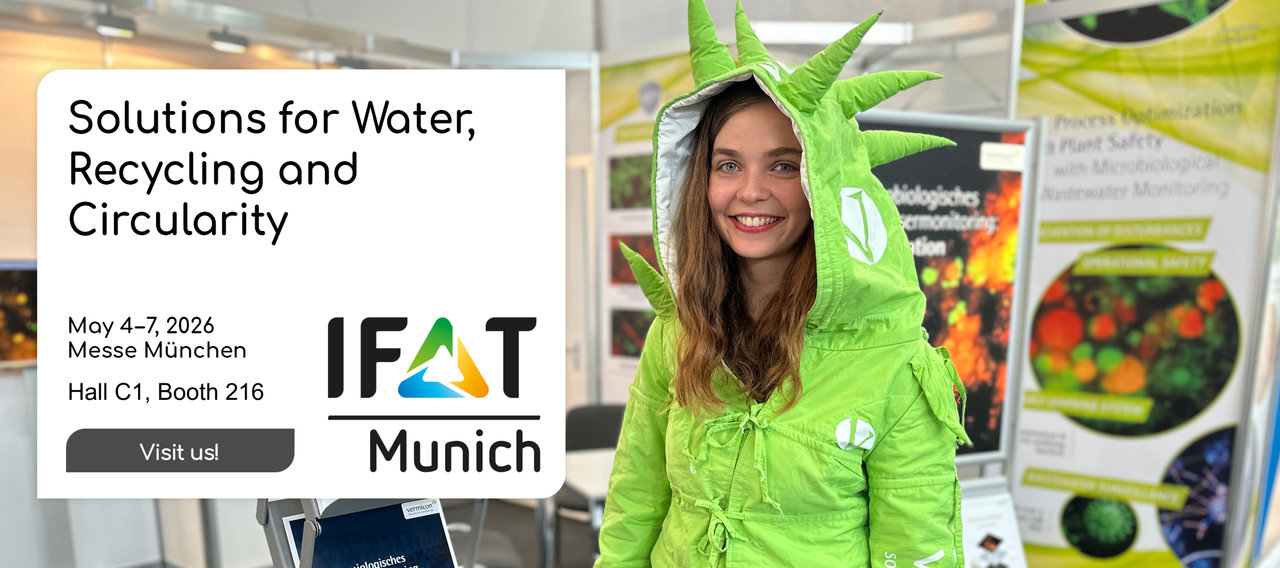
IFAT 2026 begins on May 4 in Munich, celebrates its 60th anniversary and will also take place in a condensed form, as the trade fair will only run from Monday to Thursday in future.
It is now called "Solutions for Water, Recycling and Circularity" more precisely than ever before, making it clear from the title what the industry has long been concerned with: Water, waste water, material cycles, resources and energy can no longer be considered separately. More than 3,200 exhibitors from over 60 countries are expected in 2026. in 2024, 142,000 visitors from 170 countries already attended, the trade fair occupied 300,000 square meters, and ten halls plus an outdoor area were dedicated to water and wastewater alone.
IFAT as a strategic platform
This is also remarkable: 80 percent of the trade visitors were at decision-making level, and the trade program comprised 418 individual events. These figures are not just a backdrop. They show that IFAT is no longer just a product show, but a place where strategic decisions on the direction of an entire infrastructure sector are made.
New regulatory framework conditions
This is relevant for wastewater experts for one simple reason: Biological wastewater treatment is under different pressure than it was just a few years ago. The amended European Wastewater Directive expands the requirements, increases the requirements for nutrient retention, enshrines the removal of micropollutants, aims for energy neutrality of wastewater treatment plants by 2045 and explicitly makes the monitoring of health parameters in wastewater a regulatory issue.
At the same time, expectations of process stability, energy efficiency and data depth during operation are increasing. The traditional view of aeration, i.e. measuring solids, monitoring operating values and only reacting to anomalies, is becoming less and less sufficient under these conditions. The industry is therefore moving towards finer, more biologically resolved process control.
Biology as the key to process control
This is precisely the real significance of IFAT 2026 for the water industry. It is not just a meeting place for machines, units and process engineering solutions, but increasingly a forum for the question of how biological systems in wastewater treatment plants can be understood more precisely. This is because the critical points often do not lie in the effluent, but much earlier in the biocenosis itself. Whether nitrifiers are working stably, filamentous populations are becoming problematic, the biomass is coming under stress or the actual biological performance reserve is decreasing can only be recognized to a limited extent with rough sum parameters.
Anyone who wants to manage biological systems economically and robustly therefore does not simply need more data, but data with biological significance. This is precisely where the industry's technical focus is currently shifting.
The IFAT presentation of vermicon AG also fits into this context. In Hall C1, Stand 216, the company is not exhibiting an isolated individual process, but an integrated concept that responds to the current logic of modern wastewater treatment plants.
The focus is on three levels:
The direct analysis of microbial communities with VIT® gene probe technology, the measurement of living biomass with the VIT® ABM system and virus analysis using VIT® qPCR test kits for complex wastewater matrices.
It is not so much the list of these three technologies that is interesting as their interrelationship. Taken together, the composition of the biocenosis, the state of the active biomass and epidemiologically relevant signals from the wastewater form a much more complete picture than each of these pieces of information on its own.
For operations, this means one thing above all: decisions can be made earlier, more reliably and with better biological justification - while at the same time ensuring maximum regulatory compatibility.